
How Progressivism Died
A letter to a late leftist on why their political identity no longer makes sense

Something happened in 2024.
On that point, everyone agrees, even if no one can pinpoint exactly what changed. Commenters call it a “Vibe Shift”, or yet another turn in our ongoing cultural revolution. Still, the difference is undeniable. People aren’t thinking about their future in the same way they were in 2018, and the old political formulas, once almost indestructible across the Western World, are collapsing before our eyes.
In America, the Republican Party of Ronald Regan has been crushed under the merciless boots of Trumpist populism. The Democrats languish, adrift in the consequences of a future they created but which failed to provide them with the unassailable political power they had hoped for. Meanwhile, mainstream political parties in Europe seem to be experiencing a more profound crisis. Sitting atop status quo-oriented political systems, the continent’s social democratic leaders struggle to maintain a basic standard of living as their societies’ social cohesion collapses under the diversity they have invited in.
Likewise, the online space has been similarly shaken by this cultural turmoil. Both left-wing and right-wing radicalism have experienced a resurgence for nearly a decade. Still, despite their ascendancy among the youth, neither political faction remains able to gain traction within a political mainstream dominated by Boomer complacency. Each now possesses numerous theories about how to address modernity’s problems, but few practical avenues for solutions.
Moreover, with the oft-discussed “death of discourse” on the internet, there are few opportunities for engaging in interesting conversations with the other side. People don’t debate, they purity spiral; and the temptation towards infighting constantly diverts political energy into futility and drama. It’s easy to see the need for political solutions, but in 2025, people are wondering what the next steps would even look like.
For my own online “Dissident Right” sphere, I can recognize the problems of political dissatisfaction well enough. Ten years out from the high-water mark of anti-progressive, critique-based politics in 2017, right-wingers have had to forge new identities and approaches to ideas that are independent of their general distaste for leftism.
Subsequently, content creation has gotten more challenging.
It’s not that the quality of the content got worse. In fact, the quality has improved significantly to the point where there are now many more talented individuals producing excellent work than I can even keep track of. Nevertheless, the fare being produced is much less digestible, as it is inevitably difficult to explore complex modern cultural problems and their thorny practical solutions in a way that feels cathartic.
In 2024, as some of the novelty of the initial NRX explosion wore off and more intra-right political fissures formed, many commentators speculated that the “online right” or “Dissident Right” was in terminal decline, destined to be remembered as a fleeting phenomenon of the late 2010s and nothing more.
The supposed “demise of the online right” was interesting in concept. However, much to the chagrin of its critics, the so-called “Dissident Right” wasn’t going anywhere. As I pointed out in an article one year back, despite its manifest weaknesses, what people had labeled “right-wing” was going to be an immovable fixture of modern politics since, at its core, it was a simple response to the failure of liberal ideas to account for the realities of the contemporary world.

People might take issue with the current crop of influencers on the right, dislike their unpalatable message, or balk at the harsher solutions they propose. Nevertheless, the online right was engaging with an inevitable reality about humanity and politics in the 21st century that their opponents were not acknowledging. And rage as they might, the critics could not veto these hard truths from political discourse.
Fast forward a year to 2025, and nothing much has changed. The salience of mainstream political discourse has continued to decline, while the challenges of modernity have sharpened. Despite numerous predictions of its failure, the post-liberal right-wing has continued to grow apace, even if, in the second Trump Administration, generating clickbait online articles about the wretched state of things is not as popular as it used to be.
I suppose there is always a minor consolation being furthest from the party ostensibly “in power”. It’s easier to develop a political narrative when all of the thornier questions about the challenges of modernity are hidden behind the larger struggle to weather the abuses of the American administration. Just as right-wingers learned in 2021, the worst places politically are often the most fertile for the development of radical political identities.
But that being said, how is the left faring in 2025? Shouldn’t they be experiencing a similar moment of generative alienation?
How are the fortunes of the Bernie Bros? The dirt-bag Marxists of Chapo Trap House? And the luminaries of “Bread Tube” who, not but four years ago, seemed to stand astride the world as the West’s most significant radical alternative to Global Techno-capital?
How goes progressivism in 2025?
Not well, it would seem.
In fact, I would venture to say that the modern 20th-century left is experiencing a kind of terminal decline that cannot be reversed and that will, in due course, render its approaches to politics fundamentally irrelevant.
Of course, many statements about the “death of the left” or the elite “putting the woke away” are overstated. In fact, most, if not all, of the triumphalism in the wake of the second Trump victory is Pollyannish Boomer slop, pretending that we can fix deep civilizational structural problems by “voting harder”. In reality, regardless of the fortunes of the Democratic party, the ascendancy of progressive ideas across the late 20th century has had near-indelible consequences for the world we occupy in the 21st. Demographically, religiously, and sexually, too many Genies were released from too many bottles, and these Djinns aren’t returning to their exile anytime soon, not without a fight.
The scourge of “leftism” and its consequences, in the most general sense, isn’t going anywhere. After all, the forces that produce leftism are still in effect: technology, the perverse incentives of managerial control, and the unstoppable force of entropic cultural chaos. And humanity will have to struggle against these temptations for as long as it walks on this fallen earth.
Still, in 2025, some form of progressivism is indeed in the process of dying, even if it resists being labeled easily.
What might we call this political movement that so dominated the previous century but now seems to be fading away?
Modern Progressivism? 20th-century leftism? The cult of liberal progress? The cause of emancipatory egalitarianism?
I might jokingly call it the “White Left” if I wanted to raise hackles and weren’t adverse to creating a new James Lindsayism.
However, labeled or not, the phenomenon is easy to observe, historically speaking. Modern progressivism is the perspective of history and politics that was born from the Enlightenment and the French Revolution in the 18th century, transformed by the explosion of technology and science in the 19th, and then granted its final political ascendancy over the globe in the 20th. This is the politics that rules our world, the politics of the end of history; it holds all the keys, it guards all the gates, it sits in the seat of power and calls the shots even when Republican presidents happen to get into office.
Still, the perspectives of 20th-century progressivism are defunct. Its political formulas are in shambles. And increasingly, being a leftist, at least a white leftist, will make less sense, even though it might not be immediately apparent.
Strangely enough, whether coherent or not, leftist media has become much more entertaining in 2025. Progressives now suspect that their identity has a problem. However, the only people willing to examine the issue appear to be totally incapable of understanding the magnitude of the problem. Luminaries talk about “abundance”, “outreach”, and even “socialism” to address the symptoms of the modern condition, but all the while studiously ignore the elephant in the room, an elephant saying simply: “Progressivism makes no sense, anymore.” The core problem couldn’t be clearer, but leftists themselves have become skilled at missing the reality sitting right under their noses.
Examples abound.
The Democratic apologists at the New York Times think they have a problem getting men to vote blue. But what they really have a problem with is their total inability to understand human social dynamics, gender relations, and how sexuality actually works at a basic level.
Moderate progressives think they have a challenge with providing “abundance” and delivering on material promises. However, in reality, their issue is that they don’t understand the nature of expertise and technology, as well as their relationship to broader human well-being.
Socialists think they are having difficulty appealing to the “multi-racial working class”. But in fact, they fail entirely to understand what class politics is.
Leftists lament the fact that they have not yet discovered a realistic vision for a post-capitalist world. But their entire worldview is a mass of walking contradictions designed to be an appealing entertainment product for the West’s underemployed, over-educated, overproduced elite class.
Like a woman checking into a cosmetic skin care clinic with metastasizing melanoma, modern progressives are totally unprepared to take stock of the magnitude of their problem. Their belief system won’t be fixed. It’s just plain dead, and the movement needs to stop planning the victory parties for its eventual world domination and start thinking about its life insurance policy and living will.
Cope springs eternal.
Modern leftism is dying, and the repeated attempts of Millennials and now Zoomers to live the dream they heard sung by their parents in the lyrics of John Lennon’s Imagine are transparently futile. I would feel sorry for the young people who got caught up in this sad 20th-century mythology if they hadn’t made a habit of being excessively cruel to their political enemies for the last decade.
Nevertheless, show me a Millennial leftist, and I will show you an extended attempt at LARPING a political fantasy from 50 years ago. Like the Boomers reenacting their desire to elect Dr. Martin Luther King Jr. as President by voting for Barack Obama, young progressives attempt to replicate tropes from earlier eras by projecting their desire for “safe-edgy” revolutionary vitality onto a contemporary political movement that only produces degeneracy, hedonism, and learned helplessness. They want to summon the energy of a previous era, like launching an app on their iPhone, but that’s not how authentic politics works.

Whether it’s Nathan Robinson cosplaying as Eugene Debs while firing his employees for unionizing, or Joshua Citarella searching for the spirit of the working class by interviewing high-class Silicon Valley corporate whores, modern progressives exist in a constant state of futile nostalgia. Frankly, I’ve seen more self-awareness from the guys who dress like Vikings and talk about sacrificing goats to Odin.
And this June, the Millennial left received their latest fake bump with the ascendancy of Zohran Mamdani within the primary of the New York City mayoral race, perhaps indicating the long-prophesied sea change in American politics. For a while, it was impossible to go anywhere near the progressive side of the internet without seeing them soyjack over their own mini-socialist revolution.
Was this the moment that the progressive movement had arrived? Was this the turning point where ideas talked about only on Blue-sky would become the new political reality of the United States of America?
Fat chance.
Mamdani is as fake as politicians come, astro-turfed to the core. And to the extent that he represents anything, it is much less socialism and much more the emerging ethnic nepotism of new immigrant communities, as the man himself admitted. For the insightful observer, it is very clear that Zohran is much less a younger, browner version of Bernie Sanders, and much more just the left-wing version of Vivek Ramaswamy. The resemblance is impossible to miss when you hold them up, side by side.
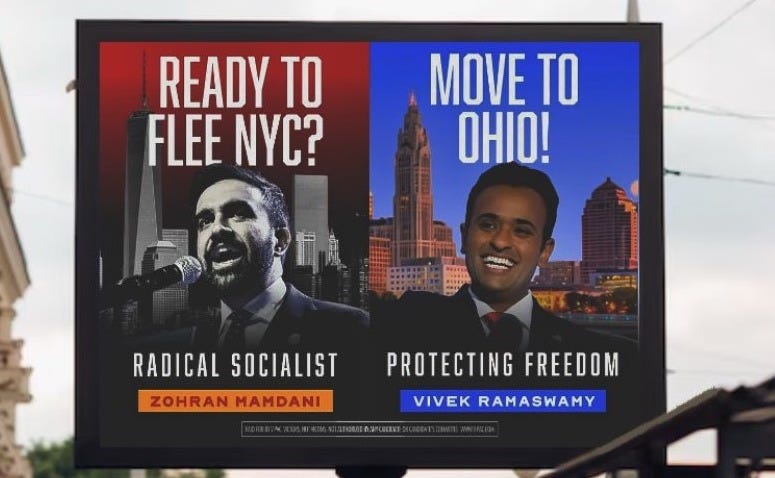
But no one is paying too much attention to these tell-tale signs of mercenary political ambition in NYC’s new progressive prince, just as long as Mamdani is singing the sweet song of socialism, and selling beautiful lies to Gotham’s young white fail-sons.
Really, although the analogy is overused, I can’t look at this moment in New York City without feeling like I am watching professional wrestling. What we are seeing isn’t a real political movement; it’s a performance. And, like pro-wrestling fans, at a certain level, I think that most progressives understand that they aren’t leading a real socialist revolution. The promises made by Zohran Mamdani are fake, intended solely for entertainment purposes. No doubt, the cause of radical socialism will be back to square one in another 6 months. But the ride will be fun while it lasts.
However, just as in pro-wrestling, there are always those fans who can’t see through the Kayfabe, the people who don’t understand the limitations of progressivism in the early 20th century, and think that the overthrow of capitalism is imminent. I do appreciate true-believers of any variety, but I always wonder how long the illusion can last. How can somebody who is reasonably intelligent not see the implicit fakeness of the progressive cause in 2025? Is it willful ignorance? Or just an extreme form of naivete?
A somewhat unusual example of one of these leftist true believers came across my Substack feed a few weeks ago, when I found a piece by Stella Tsantekidou at her blog The Human Carbohydrate. From what I have been able to surmise from her work, Stella is a classic socialist, operating in the pattern of men like Mark Fisher and Slavoj Žižek while nevertheless submitting to modern 20th-century liberal orthodoxies. A Greek expat in Britain, Tsantekidou bills herself as a “reverse Lord Byron”, which I assume, given her progressive sensibilities, means that, just as Byron fought against the Muslim domination of Greece, Stella now fights to ensure the Muslim domination of England.
It’s like they say. History doesn’t repeat, but it does rhyme.

However, jokes aside, what struck me about Stella’s work at The Human Carbohydrate was her tireless dedication to dialogue, seemingly untouched by the cynical political perspectives that had overtaken leftism since the early 2010s. For the longest time, I have believed that some synthesis between left and right was needed to properly replace the ideologies of the 20th century. Might Tsantekidou’s writing about reactionaries be the first step to a productive post-liberal political project?

Perhaps not.
From what I have seen, the author’s writings are a perfect example of how many sincere left-wingers are still stuck within the illusions of the 20th century.
In her articles, Stella expresses the typical run of leftist opinions that strike all right-wingers as naive. She employs a sloppy approach to political language that divorces words from their basic meaning, using terms like “Democracy” and “Socialism” as stand-ins for all good things, while “Capitalism” and “Imperialism” act as functional synonyms for everything evil. There is also the perennial sense that Stella’s understanding of political solutions doesn’t involve making hard decisions with trade-offs, but just requires defeating the bad ideas and bad people behind them, essentially the politics of Captain Planet and the Planeteers. Yet stranger still, Tsantekidou expresses the belief that Greta Thunberg is a real-life radical activist risking her life to speak truth to power, and not (as seems obvious to most) a celebrity plant, staging protest theater for the entertainment of rich Boomer women.
Still, leftist cliches aside, what really struck me when reading Tsantekidou’s blog was its bizarre attitude towards discourse in 2025. For some strange reason, the author seemed convinced that it was right-wing beliefs that were uniquely vulnerable to open inquiry in the present year, with reactionaries unable to confront left-wing arguments, retreating to their echo chambers and cancelling naysayers to preserve their cherished prejudices. In Stella’s understanding, it was just this contemporary moment, when a brave leftist might bring enlightenment, showing them the pure rhetorical force of the progressive truth, which modern right-wingers certainly had never heard before.
At the risk of sounding entirely condescending, I couldn’t help but laugh at the premise of this article. How could an otherwise inquisitive thinker get the cultural dynamic between the modern left and right so entirely backwards?
I don’t mean to bash leftists here, not entirely. As the poet once said, “there are good people on both sides”. However, their other virtues aside, modern progressives are not known for holding their own in a sincere and extended dialogue with their political opponents. For the most part, leftists prefer quick interactions that emphasize optics and soundbites, almost always choosing to divert conversations into moral indictments and appeals to expert authority rather than coming to terms with the core differences in each side’s values.
Once more, progressives in 2025 have many things that they do well, but introspective and critical dialogue is not one of those things. That’s not the kind of thing that progressivism is anymore.
Tsantekidou’s article reminded me of a conversation I had with a classmate in primary school, who argued credulously that the WWF’s Ultimate Warrior could defeat both Mike Tyson and Evander Holyfield in a boxing match because he was, by definition, “the ultimate warrior”. Sure, I understand that my friend watched a lot of pro wrestling, but he still didn’t understand what he was watching, because he had missed one of its core qualities.

To be clear, I am certainly not trying to downplay the sheer mental gymnastic talent required to present yourself as an authentic socialist in 2025, but leftists aren’t playing the same kind of game as their counterparts on the right. Socialism in the 21st century isn’t trying to build power and capture resources for the future. It’s an entertainment fandom. Just like Greta Thunberg’s career as an intrepid blockade runner sailing ships to deliver food to starving Palestinian children, it’s all fake. The left doesn’t make real political plays or build real communities; it just orchestrates stunts. And whatever power it retains is granted to it from above by the rulers of the status quo.
The whole interaction with Stella Tsantekidou had me realize that, before any productive conversation could occur between left and right, there needed to be an awareness of the futility of progressive ideas in 2025. After all, the right wing wasn’t able to do anything productive until it realized that conservatism and libertarianism were political dead ends. Could there be a similar revolution in self-awareness on the left?
In her article, Stella writes that people don’t change their political opinions because their opinions are so intimately linked to their identity. But that’s just the problem with modern progressives.
It’s not that leftists don’t make some good points occasionally or have legitimate grievances. The problem is not some specific logical flaw in their arguments (though there are many). The problem is that their whole identity no longer makes sense. Progressivism itself has become incoherent at its core, and as such, it can only relate to the world through a medium of irony and performance.
Modern leftists are trying to play a certain role in society that no longer exists by pushing a perspective that no longer fits with the social reality on the ground. The core modes they use to relate their existence to the problems of the modern world are defunct, and so their approach can never connect with the reality of extant human problems.
But what exactly are these failed modes of leftist identity that don’t make sense in the modern world?
I can think of at least five.

Failed Progressive Mode One: Whiggish Historical Optimism
Before discussing the failures of modern progressivism, it might help a reader at least briefly to review what I mean by “progressivism”. For our purposes, when we examine the politics of progress in this way, we are defining the concept less as the eternal force of rebellion and chaos, and more as the specific political perspective dominant in the West for the last two centuries.
Uncontroversially, progressivism comes from the Enlightenment. It is less the product of some specific thinker, and more the result of a general feeling, ubiquitous across early modernity, that mankind could transcend core elements of the human condition and discover a new set of secular values as a functional replacement for the traditional Christian worldview.
But if not Christ, what did these new modern thinkers believe in?
Democracy? Equality? Liberty?
One might say that Enlightenment thought pursued “emancipation” in the broadest sense, the freeing of man from all unnecessary constraints. However, it wasn’t immediately clear where those unnecessary constraints began and ended. Under the conditions of the old world, everyone could agree that man was shackled by the tyranny of kings and unreasonable religious doctrine. But how far was the emancipation of the will supposed to proceed?
No one could provide a consistent answer or even describe how the values of liberation might be balanced with the Enlightenment’s seemingly contradictory commitments to things like equality and democracy. Nevertheless, the zeitgeist of the 18th century carried forward apace.
Ultimately, what came to characterize this “Enlightened” perspective was less a philosophy and more just a direction. Just like the progress of science, there emerged an unshakable belief that mankind might make a similar type of progress in social relations by deconstructing the barriers of inherited religious systems and cultural traditions. As long as humanity kept pushing at the boundaries and questioning assumptions, the thinking went, the lot of mankind couldn’t help but improve. Thus, rather than a specific philosophy, the Enlightenment produced something much more substantial: a new progressive model of history, the Whig understanding of human events, where the mere passage of time would inevitably improve humanity’s quality of existence.
Of course, this understanding of progress was always a myth, even in the early modern period. The promises of the Scientific Revolution and Enlightenment soon gave way to the Industrial Era and new “democratic” forms of government after the French Revolution; and far from providing mankind with an unmitigated benefit, these developments possessed numerous and obvious downsides.
The Industrial Revolution, while generating profound improvements in productivity and medicine, nevertheless stifled local folklife, centralized power, and in many ways degraded the communal health of the very populations required to power its engine. Meanwhile, the new republican Governments, far from solving the problem of tyranny, often proved to be more corrupt and bloodthirsty than the Ancien régimes they had replaced, and also (paradoxically) less popular.
For the belief in progress to survive the 19th century, a political formula was needed to separate the “good” type of progress from the “bad” type of progress, a perspective that was hopeful but that did not rely on thornier pre-modern concepts like religion or teleology. Thus was born the modern form of progressivism in the West. Whiggish in historical outlook but ultimately managerial and technocratic in application, the political mode promised the application of human thought to discover the optimal system of political organization able to solve the problems of the Industrial Age and its political instability. Thus, in theory, a progressive political order would ensure that man would enjoy the same improvement in his social arrangements as he was experiencing from his rapidly developing technology.
It sounds strange in hindsight, but across the last 100 years, it’s amazing how much political conflict just came down to contests between rival progressive managerial systems not significantly different from each other. But the wars needed to be fought in the name of those small differences to prove that the victors were on the “right side of history”. It was the story that modern people all believed, the story that modernity demanded.
For example, what is the lesson of the 20th century?
Ask anyone in America or Europe, at least ten years ago, and their answer would be consistent. The story of the 20th century was that of Social Democracy’s triumph over all other rival systems and its (supposed) progress towards the emancipation of humanity generally. The narrative made sense inside a crude utilitarian framework. Modern Western societies had the highest standard of living in human history, and more higher standards meant more better.
It’s hard to argue with results.
Still, looking at the problem more carefully in the present year reveals the hidden hat trick in play. Most of the utility of modern Social Democracy in the 20th century was generated from the widespread distribution of one-off scientific enhancements, making their supposed “superiority” a product of being present for the better half of the Industrial Revolution. Once that economic advantage was exhausted in the 21st century, the implicit advantages of the Western liberal systems evaporated in turn.
But the problem was worse yet, since it seemed as if the incredible wealth generated inside Western liberal societies had covered up a growing social degeneracy that would have otherwise been obvious. Subsequently, in the early 21st century, as the developments of technology became less immediately beneficial, the rank degeneracy brought about by the West’s collapsing social system became ever more obvious, and the idea that modern liberal social democracies represented a point of apex historical progress seemed farcical.
Certainly, this is a problem for Whiggish neo-liberal types like Francis Fukuyama. But is it a problem from more orthodox radical leftists, very few of whom see social democracy as a desirable end goal in 2025?
Well, yes, because progress, qua progress, is critical to the left’s understanding of itself, in either its moderate or radical form.
Since the beginning, progressives believed themselves to be part of an inevitable historical force that was imminently making things better. Optimism was one of the most marked traits of early leftist thought. Its followers might lament the sad state of things, but they possessed an unshakable certainty that history was on a trajectory ever upwards, the reason why they gravitated to the label of “progressive” to begin with.
Even Marx, though dabbling in doom-saying about “Capitalism”, nevertheless made a sense of inevitable evolutionary development core to his historical theory: dialectic materialism. In fact, I don’t think his type of socialist theories would have become nearly as popular among the intellectual class of the era had they not proposed a moral system grounded in this concept of continuous improvement in time. After all, things were always moving forward, so communism just made sense if its development from capitalism was a natural extension of the progress humanity had already accomplished, moving away from pre-modern systems and into the modern world.
Similarly, the astounding economic growth of the 20th century reinforced leftist confidence in the necessary upward pattern of history, even if said “progress” was accomplished under distinctly capitalist systems. If improvement was always the expectation, it seemed logical that the social democracies that produced such abundant wealth would also improve their governments by adopting socialism to more widely share their resources. And indeed, such a “socialization” process was already underway through Western nations’ ever-growing tax-funded entitlement programs.
Of course, socialism works! Look at all these new “socialized” programs and how popular they are!
But even this success was deceptive and a product of unique historical circumstances.
If the institution of the National Health Service is packaged with the recent development of penicillin and the polio vaccine, then it will be hailed as an unmitigated improvement of the human condition. But this popularity was dependent on these programs being the public face for the distribution of technological benefits not yet widely available. And these technological benefits were not bottomless. When similar attempts to “socialize” the medical systems were made decades later, the developments were much more controversial, as the trade-offs between costs and benefits were immediately apparent.
And a similar decline in the notion of progress can be seen across the board in other human endeavors. We are no longer in a mode of unbounded growth, social programs no longer pay for themselves, and the pathologies of immigration and social dissolution can’t be absorbed into an infinitely growing supply of collective trust and wealth. New political questions are now primarily about fighting for survival in a zero-sum world, rather than spreading a growing standard of living to a larger set of people. Even the new technologies emerging don’t seem particularly beneficial, often raising more political questions than they answer.
Increasingly, in the early 21st century, little appears to be progressing, and much is manifestly deteriorating.
But can progressivism exist inside a culture that lacks the conviction that history naturally improves the human condition?
In my view, the answer is “No”.
Leftism, as we know it, cannot exist outside the context of a Whiggish understanding of history because the existence of decline immediately conjures the specter of zero-sum games and real political conflicts. Under such circumstances, the popular Enlightenment untruths about human nature become more obvious and subsequently less appealing.
It should be unsurprising that, in current year, the left wing has decidedly become less hopeful and more paranoid. The progressives of the early 21st century are less focused on actively constructing alternative systems of social organization and are more concerned with making theoretical deconstructions of power. The naturally optimistic and future-looking progressives of earlier generations have been replaced by a more Millenarian (dare I say “gnostic”) set of thinkers who see capitalism and imperialism not as doomed fixtures of a bygone era, but rather as indestructible components of reality responsible for all life’s oppressions.
This more pessimistic perspective is obviously degenerate, but it allows the modern left to come to terms with its other contradictions and failures. There can be no socialism if the repression of any minority group exists, no matter how small, and there is no ethical consumption under capitalism. As such, it doesn’t really make sense to build anything unless every apparatus of potential repression is criticized and purged from the minds of the believers. As the ContraPoints meme goes, the modern left doesn’t want power to make a better world; they want to endlessly critique the powers making the current world worse.
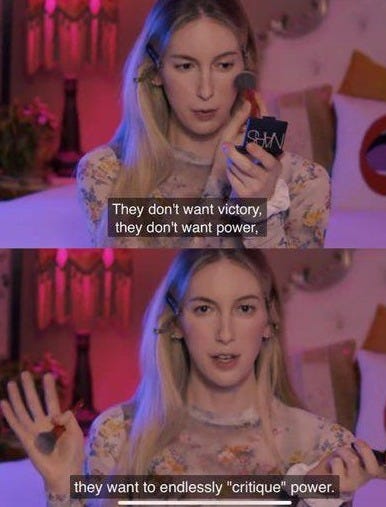
But other than the eternal (entirely hypothetical) revolution against reality, what else could leftism be when it no longer believed there was a guaranteed historical movement towards progress?
One interesting alternative, briefly explored by Mark Fisher in Capitalist Realism, was to confront the problem of modernity head-on and acknowledge the end of social progress in order to come to terms with what remained in the ashes. Certainly, Fisher’s approach to the problem was noble but ultimately futile since recognizing the parameters of modernity had a deeply enervating effect on the constitution of the left, locking them into a type of spiritual nihilism. Furthermore, this realist perspective required progressives to take a harsh look at their own identitarian affiliations, which many found impossible, and so most thinkers eventually just abandoned the approach altogether..
Ultimately, in the modern condition, the left increasingly requires an eschaton, or end-of-world scenario, to reset the course of history and restore the proper evolution of human events towards eternal emancipatory utopia.
Enter here the omni-cause of “Global Warming” or “Global Climate Change”.
For more than two decades, I have been somewhat obsessed with the cause of Climate Change and the role its narrative played in left-wing politics. Without getting too much into the details of the issue, it might suffice to say that while the basic consensus about greenhouse gas and carbon emissions is correct, the species-ending apocalyptic predictions you hear routinely from people like Greta Thunberg are hysterical hogwash.
On sober analysis, most people who look at the problem of Global Climate Change recognize an otherwise manageable problem that must be confronted through adaptation. However, you won’t hear this reasonable perspective from any modern progressive, instead its nothing but wall to wall hysteria, moralized language, a rage against bourgeois life, followed by a demand for political conformity towards an overhaul of the economic order directly in line with what leftists already wanted, restoring the errant pattern of history to their preferred progressive direction.
Here, the eschaton of Global Warming saves the left from a political crisis. But it also saves them from a spiritual crisis. The angel of judgment, in the form of Gaia, now descends upon a sinful humanity gone astray, bringing its wrath so that whatever remnant is spared may continue on into the future with the proper historical mode restored, always in the direction of greater emancipation.
It might sound like a religion, but it’s actually science! At least that’s what the experts tell us, which brings us to the next big problem facing leftism.

Failed Progressive Mode Two: Expert-Obsessed Pseudo-Intellectualism
I arrive now at the most prominent feature of 21st-century progressivism, namely its obsession with academia and expert consensus. No one who has had a conversation with a modern progressive can avoid this mode of discourse, where every preference and opinion is asserted confidently behind endless appeals to expert authority and credentialism, with seldom a sincere confession of belief or reasoned argument to be found.
You know the refrain:
Experts Agree!
Citation Needed!
Trust the Science!
Even after these Reddit tropes became self-parodies online around 2020, the trend towards academic “consensus” brain rot remained dominant within the pages of elite media. Now, in 2025, being progressive means being aligned with the prevailing expert opinion, or, failing that, believing that the real focus of political discourse should be getting the elite “smart set” on your side. Progressives trust “The Science-TM”, even if they don’t otherwise believe in trademarks.
But shouldn’t we all put our pride away and defer to the facts of the matter? Shouldn’t people be committed to the Truth? What’s wrong with science?
On its face, nothing is wrong with the scientific method. And we should all be deferential to the truth. But if you are on the political left, the deference to facts is an easy virtue, at least if the facts come from the modern academy.
Just think, how many times has this “Expert Consensus“ been used to publicly shame progressives for their heterodox views? Is that even something that could possibly happen?
Predictions are hard, especially about the future. But for some reason, leftists are always on the right side of emergent facts, politically, even when they are on the wrong side of the preponderance of the evidence.
I certainly remember how the debate over COVID origins worked. Up until 2021, the progressive consensus spoke with one voice, denying the lab leak theory and calling dissenters conspiracy theorists for saying otherwise, despite its complete lack of evidence to support this consensus. Then, in 2025, when political circumstances forced the truth to the surface, suddenly the experts were much less interested in condemning wrongthink. They didn’t even apologize for getting it wrong.
“This isn’t what we are talking about anymore,” the consensus types said. It’s funny how it works that way.
Isn’t it also funny how, despite having a purportedly “fact-based worldview “, progressives never need to change their opinions about anything, even as the facts are rapidly shifting on the ground. Instead, the narrative shifts around the inconvenient truth, always focusing on the things that vindicate the leftist worldview and away from its mistakes. Somehow, regardless of the impacts on humanity, the academy only considers a fact important to the extent that it flatters the progressive ideology.
Everything else goes straight to the memory hole.
Thus, Catholics need to apologize for their Church coming down on the wrong side of heliocentrism, a century before the development of Newtonian physics and modern telescopes. Meanwhile, Harvard doesn't bat an eye when telling parents they can chemically castrate their sons to turn them into daughters. The recommendations aren’t even based on evidence. But “gender-affirming care” is still “scientific” because it comes from the elite academy.
My friends in the medical profession tell me that a major correction on the issue of transgenderism is in the works, percolating slowly through expert communities. Nevertheless, the progressive fanatics who drank the Kool-Aid over this hysteria don’t need to sweat it. If there ever comes a reckoning over the political corruption that ruined scores of young people’s lives through “gender reassignment”, then rest assured, “transgenderism” will suddenly become “something we aren’t talking about anymore”.
For progressives, “trust the science” means never having to say “I’m sorry”. The consensus always comes through for them.
But leftism wasn’t always like this.
Before the ideological consolidation of the university system, there was a brief period when progressives liked crackpots and other fringe thinkers who broke the mold. However, as the orthodoxy of the 20th century consolidated, a more open epistemological approach to knowledge became increasingly unacceptable to those of a progressive persuasion.
And to be sure, the moral alignment of academic experts with progressive politics has been one of the most effective assets for left-wing causes in the 20th century. And the association of liberal politics with science may have been the critical “Silver Bullet” to slay populist resistance to leftism and sell people on the promise of progressive government reform.
After all, Society needs a political order and a moral direction. What better place to look for a truly “objective” ideology than the same universities producing all manner of incredible scientific advancements?
Human nature being what it is, proximity equals association, and if your church is located next to the test tubes and cyclotrons, eventually, people think that your church’s doctrine comes from the test tubes and cyclotrons. So, naturally, modern people treat progressive values as the scientific default, as if scientists have observed the imperatives of Diversity, Equity, and Inclusion in the same way that they observed the patterns of the Higgs boson.
That being said, what exactly is the problem with this tight relationship between a society’s guiding moral ideology and science? Aren’t they all part of the same dedication to Truth, Goodness, and Beauty?
Indeed, I must concede here that a certain level of bias is inevitable in all systems of thinking, regardless of the specifics of the ideology. One of the core mistakes of the Enlightenment itself was the assumption that perception and value could be neatly and practically separated along the narrow lines of “is” and “ought”.
In reality, while the “fact/value” distinction is quite real in an abstract philosophical sense, the quality of real contemplation cannot be divorced from the moral quality that guides it. There is no such thing as value-neutral education because there is no such thing as value-neutral thought.
Behind every question of fact measured in terms of “true” and “false”, there is a second-order question about value that concerns the importance of that truth. Thus, even on a fundamental issue of fact, an implicit, motivating moral drive is necessary to direct a thinker towards understanding the object of his study.
However, the problem with the progressive ideology that currently rules the academy is that it does not understand what it is. In order to portray itself as the objective and inevitable outcropping of historical progress, modern liberalism denies its own nature as a particular religious system using self-referential word games. As a consequence, Modern progressive thinkers disregard the care that needs to be taken to preserve the necessary elements of human society, all the while failing to guard against their own ideological bias.
As Jonathan Haidt and many others have pointed out, all moral and religious views have a corrosive effect on epistemology. Humans have a hard time understanding obvious truths when they contravene narratives with deep moral meaning. Under ordinary circumstances, this is an unavoidable cause of ideological corruption. The necessary presence of a religious instinct means that institutions that guide human thought will inevitably have blind spots.
However, as it exists, modern progressivism represents the perfect storm of politicized bias. It is a religious cult of politics that simultaneously doesn’t understand that it is a religion. Leftism consistently locates its religious totems at the center of the critical political issues of the age, bringing mindless moral fervor to the exact controversies where sober and considered analysis is needed. One couldn’t develop a situation better calculated to maximize the negative impact of ideologically captured consensus, while minimizing society’s awareness of the problem.
But how did such a uniquely perverse system come about?
As Nick Land and Spandrell have pointed out, the problem goes to the heart of discourse itself. Inside systems of politics that prioritize equality and consensus over strength and competence, politicized lies will always monopolize power. Being a strong leader may earn loyalty temporarily. Being correct and fixing a problem might make you popular for a time. But creating a permanent political hysteria around bullshit that villainizes your enemies and rewards your friends will create a solid political block permanently.
“We need urgent action to pay my political allies, otherwise extra-dimensional triffids will steal our children’s eyeballs. And everyone who disagrees is just a lying Trotskyist wrecker who wants our children to go blind!”
The more transparently fake the political concern, the more useful it is as an organizing principle. Based on their willingness to support the manufactured ridiculous hysteria, leaders can easily distinguish “friend” from “enemy”, and supporters have no incentive to betray the coalition lest they lose everything when the greater fraud is exposed.
Therefore, the inevitable result of every progressive Democratic political system is an infuriatingly consistent knee-jerk tendency towards feel-good political lies, made all the more infuriating by its claim to be the product of rational discourse. Then, when said political movement finally subsumes the centers of higher learning, we arrive at the problem we face now: the total political corruption of the academy.
The modern academic is less an explorer of ideas than an enforcer of political orthodoxies and institutional arrangements, a class of inquisitors posing as scholars, shutting down lines of questioning just at the point where they need to be examined. The role of the modern “expert academic” is, in the 21st century, a complete contradiction.
It can’t continue to go on like this, and for the most part, it won’t.
At this stage, I think we are witnessing the end of the academic system as we know it. The contradictions inherent to the mainstream university are piling up, accelerated by alternative media systems. Meanwhile, the declining demographic and financial horizons of mainstream institutions mean that Universities can no longer simply use money to cover up their problems. This collapse has been a long time coming, and even the stalwart progressive believers understand that a political identity based on continuously appealing to expert authority is coming to an end.
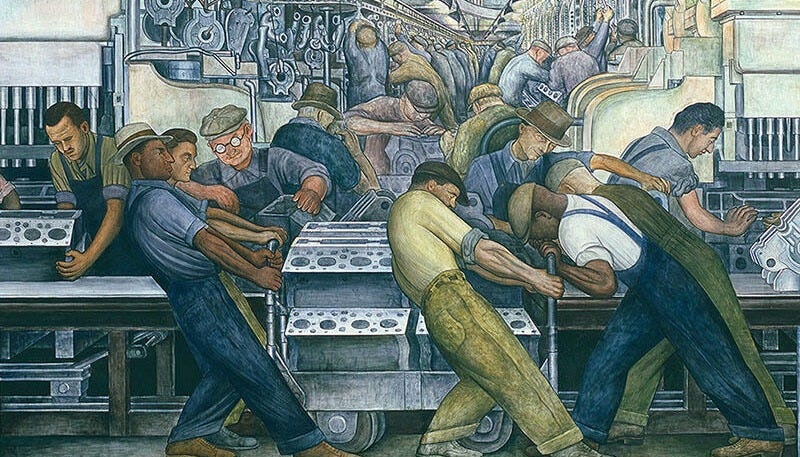
Failed Progressive Mode Three: Elite Socialist Class Politics
To this point, my exploration of these failed progressive modes may feel a bit dated.
In 2025, amid the second Trump Administration, how many leftists are still screaming about “trusting the experts” and “being on the right side of history”?
We need to examine the issues that progressives are trying to center in the current year, the left that people like Zohran Mamdani represent:
A political movement that puts economic and class politics first!
A progressive identity that appeals even to those toxic white men!
A coalition that talks about class, advocates for the working man, and wants to implement socialism!
Meet the new left, same as the old left.
Perhaps pursuing socialism is not the most revolutionary innovation - no pun intended. Class politics was at the heart of progressivism at its origin in the early 19th century, the persistent cause of its revolutionary energy in the 20th, and even the preferred direction of moderate neoliberal rags like The New York Times currently.
But is a return to class politics so wrong-headed?
In an age of economic stratification, corrupt tech elites, and a rapidly disappearing middle class, aren’t people looking for a political movement to unify all the normal people looking to secure a future for their children against the degenerative and incompetent ruling class?
Socialism seems like the perfect solution. There is just one problem. Socialism is fake.
Everyone knows that, right?
Socialism isn’t a real modern political system, and while we are at it, neither is capitalism, though that’s a different story.
We might start with the fact that the word isn’t coherently and consistently defined, and, more often than not, “Socialism” just means everything and anything that progressives like. Almost no 19th-century socialist would call the tech and oil market-fueled economies of Sweden and Norway “Socialist”. But I never met a self-described “socialist” who didn’t cite the “Nordic model” as an example of how “socialism works”. Meanwhile, other Communist societies across the 20th century that pursued the collective state ownership of the means of production (“Socialism's” literal definition) are never considered part of the “Socialist” track record.
I guess this confusion, in some sense, is necessary. Very few advocates of socialism want to get bogged down with discussions of its feasibility. The problems with planned, state-run economic systems have been well known for a century now. There are issues with incentives and the computation of prices that don’t just disappear, even with the introduction of new computational technologies. Moreover, it’s not even clear the extent to which classic socialist and Marxist critiques of 19th-century “capitalism” apply to entirely financialized economies that print their own fiat currency.
What is the socialist answer to the coming entitlement/debt bomb looming just over the horizon? If they have a solution more detailed than just “Abolish Capitalism”, they certainly don’t talk about it much.
But issues with effective implementation are not the main problem with Socialism in the 21st century. Socialism didn’t work in the 19th or 20th centuries either, and it was still very effective as a political movement. The bigger issue in 2025 for the socialist brand is that its political movement is transparently hostile to working-class interests and generally ambivalent to the well-being of the lower classes.
This is a common enough problem for leftist movements historically. Socialism was never an authentic movement of the working class. Of course, real political movements of the lower classes have always existed. There have always been peasant revolts. There have always been populist surges. There have always been grassroots rebellions. But as these more organic lower-class politics began becoming increasingly colonized by the ideology of the Enlightenment in the 19th century, they were inevitably dominated by the priorities and interests of the intellectual classes, developing in the process, their distinctly progressive flavor. The Luddite, traditionalist, parochial, and xenophobic qualities naturally found in lower classes, and which characterized more organic working class movements, were gradually supplanted by the idealism, secularism, and utopianism of the emergent dissatisfied intellectual classes.
Throughout the late 19th century and 20th century, the friction between the working class constituents of the left and their elite leaders could be easily reconciled. While the traditional aristocratic order was in power and receding, both classes had the same set of enemies. Furthermore, as the managerial class gained dominance, the seemingly limitless growth of technology and economic benefit could be used to paper over the differences in cultural priorities, always offering the lower classes newer entitlements and elevated standards of living while the thought-leaders of the movement secured powerful sinecures. However, as growth tapered off and the old system of patronage collapsed under its own weight, the dynamic couldn’t last. And as the 21st century began, leftism decidedly shifted away from its class concerns towards more specialized issues about minority identities and imperialistic oppression.
Now, in the current year, educated socialists return to form, talking about the interests of the “working class” in a broader economic sense, but the effort feels stale, not least because the interests of the creative elite classes and the middle and working classes have never been more at odds. And despite their pretension to want revolutionary social change, it is obvious to most who observe the modern left that their desired reforms would never result in any action that would benefit the native working classes of their home countries.
Is this too cynical? Just consider any practical issue that most middle-class people care about or that you and your friends express concern over, in everyday life.
Are you concerned about the unavailability of housing and the high cost of living?
Or perhaps you are angry about the many abuses of Pharma and Big Tech?
Are you disheartened by the increasing lack of middle-class jobs?
The destabilizing demographic transformation of your hometown?
The declining social cohesion and trust of your local community?
Or, perhaps you are horrified over the terrible impact of drugs and pornography on young men in 2025?
These are all very common concerns in the present day. However, to the extent that modern progressives acknowledge these issues to begin with, they never provide any solutions, at least no solutions that aren’t just blaming these problems on the bogeyman of “Capitalism” and demanding its abolition.
Of course, blaming “Capitalism” for these modern problems is a bit anachronistic. Many of these issues extend from core elements of the human condition that our government has failed to address effectively, or otherwise emerge from cultural and technological changes in the late 20th century. Is “Capitalism”, otherwise defined as a vague economic system developing in the late 18th century, really the trigger for the emergence of these problems that have become more prominent after around 1968?
It doesn’t seem likely.
Moreover, it goes without saying that, for all of this rage against “Capitalism”, there isn’t a leftist plan to tear down the extant government. In the 19th century, radicals actually wanted to smash the state. However, for their successors in 2025, even reducing the slush funds available to government intelligence services is a step too far. For modern leftists, “End Capitalism” isn’t a call to destroy the status quo. It’s an excuse used to support it. “Capitalism” is the scapegoat necessary to make people accept the degraded state of their own community, all while giving activists money to plan a revolution that never happens.
The radical leftist refrain is always the same: don’t critically examine the social changes that have taken place over the last 70 years, and certainly don’t work to reverse them. Instead, people should just get increasingly angry at a vague economic theory that doesn’t even represent how our modern economy works, all the while handing an increasing percentage of their paycheck over to establishment NGOs and government bureaucracies.
For example, look at the problems that we previously listed as common middle-class concerns. What are the “leftist answers” to these issues?
We can start with the easiest ones first. Certainly, progressives talk a good game about economics. Nevertheless, their solutions to the problems inherent in the modern economy are a joke.
It is obvious to almost anyone who looks at the issue of inflation and cost of living that these challenges emerge directly from the centralized monetary policy and banking driven by the Federal Reserve system. Modern capitalists aren’t actually participating in a market that rewards winners at the expense of losers. Rather, money is printed and loaned to investors at near-zero interest to “keep the economy growing”, inflating the currency relative to the value of production, while excess earning is taxed away to support an ever-expanding bureaucratic government principally concerned with bailing out losers who are “too big to fail”. Call this system what you will, but it doesn’t resemble anything that Adam Smith described as “Free Market” or that Marx described as “Capitalist”.
Yet when I, or any other right-winger, point to this apparatus of human misery and debt that exists at the heart of our monetary and banking system, the perfect example of corporate and government maleficence, most leftists immediately lose interest in the problem. Sure, they hate corporations and cronyism. But critiquing the monetary policy (and the money-printing bureaucracy behind it) isn’t their modus operandi.
“Why are you so obsessed with banks bro? Why are you using scary words like usury? What are you, some kind of antisemite?”
Across the board in 2025, the progressive opposition to corporate capitalism is highly selective. Certainly, leftists hate oil companies and manufacturing conglomerates somewhat, and they really hate landlords. But as the criticism drifts to more central industries like Tech and Finance, their disapprobation becomes more muted.
I have now spent the better part of a decade trying to get leftists to entertain the rampant abuse in the Pharmaceutical and Tech industries, especially in the wake of COVID. While progressives sometimes complain about drug prices and information control when it suits them, there is never a larger discussion about how these industries pushed unhealthy and addictive products on the population and killed millions. Just like the abuses of the financial sector, pointing to those kinds of problems just isn’t done; it’s a “conspiracy theory”.
And the progressive blind spots only get larger on issues that touch the “third rail” of the left’s cultural agenda.
For instance, certainly one of the major causes of the cost-of-living crisis is our society’s insane approach to unrestricted global trade and mass migration, which, in toto, skyrockets the value of capital while cratering the price of labor. The situation is a classic example of top-down class warfare if ever there was one. Still, how many leftists in the current year advocate for secure (closed) borders and trade barriers? Aren’t those sorts of things scary “right-wing” ideas?
Moreover, while progressives want a cohesive, high-trust society in theory, they will only play lip service to this goal, all the while pouring gasoline on the fires that now consume their native societies. Examples abound. We have known for decades now that diversity and mass population shifts stifle community formation and social trust. Nevertheless, promoting mass migration and open borders is a central issue for the left. It might be a “Koch Brothers” idea in its inception, but you can’t be a part of the modern left and oppose the cause of infinity Bomalians, just ask Angela Nagle.
And that’s not to mention the deleterious effects of things like pornography, social media, and drugs ruining modern people’s health and ability to form families. It is undeniable that we are in the middle of a health crisis driven by a new set of addictive hedonic technological products. Moreover, the costs of this health crisis fall most grievously on the shoulders of the middle and lower classes.
Perhaps this development is unsurprising. Vice has always been a type of class warfare. And it’s only gotten worse in the age of “limbic capitalism”.
However, when it comes to modern progressives, I generally see two responses to this health crisis:
“These health-destroying technological products are caused by capitalism!”
“These health-destroying technological products are a good thing actually, because ‘muh’ hedonistic freedom!”
But these are hardly reasonable responses to our crisis. In fact, these answers don’t even make sense by their own logic.
Pre-capitalist societies frequently have issues with drugs and pornography when it is introduced to them, which, if uncontrolled, tend to devastate traditional human communities more than their post-industrial counterparts. Furthermore, classically Marxist “State-Socialist” societies like China have only been able to clamp down on these problems to the extent that they employ the tough restrictions and paternalism that their liberal socialist counterparts in the West refuse to entertain.
Once more, I have been trying to get my progressive (now socialist) friends to take the issues of drugs and pornography seriously for a decade. I have told them about the necessary actions repeatedly. We need to deal with drug use by eliminating it, taking people off the streets, and putting them in institutions. We need to enforce the law aggressively and expand its restrictions on addictive technologies. Censor pornography, ban OnlyFans, and end the careers of celebrity prostitutes.
Yet the response is always just a shocked silence. Progressives can’t do anything about these problems beyond giving more money to NGOs because taking a more direct approach would be “Fascist”.
Don’t people have the right to find their happiness even inside degrading sexual practices and life-destroying drugs?
Our Fentanyl crisis might be caused by “Capitalism” in the most general sense, but try to get drug users off the streets, and your progressive friends will become capitalism’s strongest soldiers. Pornified dating culture might be caused by “unregulated free markets”, but try to limit people's access to this destructive technology, and your average socialist will momentarily transform into a reincarnation of Milton Friedman.
There is, in all these issues, a division between the leftist class warrior that exists in theory and the leftist defender of progressive managerial values that exists in reality. And the reality of progressive politics always wins.
The problem, most fundamentally, is that the left is not aware of its own class interest. Progressives are, for the most part, members of the intellectual professional managerial class. As such, their interests are bound up in the continued expansion of the total state and its consolidation under people who share their values. While the money was rolling in, the interests of this group could be aligned with the working class by bribing them. However, now that this “progress” has ceased, the progressive classes only gain power by maintaining dependence and covering up the corruption of institutions that support their interests.
The pattern is unmistakable once you notice it. Leftist criticism of corporate-cronyism stops the second the corporate power gets integrated into a government bureaucracy that benefits the PMC. Leftists who gladly criticize ENRON don’t feel nearly as comfortable going after the Federal Reserve. The activists who hated the Pharmaceutical companies fell silent as soon as those same corporations started working closely with government health bureaucracies during COVID.
Likewise, every time the broader forces of market managerialism seek to deconstruct an institution that once was vital to the strength of the lower and middle classes, modern progressives will always enter the fight on the side of the deconstruction.
Capitalism makes people dependent on drugs. But let’s legalize weed, remove the stigma of addiction, and not enforce vagrancy laws!
New information technologies addict people to false simulacra and make it difficult to form relationships, but let’s keep the hedonistic floodgates open in the name of “freedom”!
The forces of the market are causing the decline of families, but let’s actively promote every degenerate development of the sexual revolution!
Degeneration and dependency are the ways that the modern managerial class grows, so it must always be encouraged by the left. It’s simple class politics.
The problem is, once the modern socialist acknowledges his role in promoting malign cultural trends that function as class warfare against the lower classes, his identity collapses. As such, progressives tend to shrink from direct engagement with the populist types. They understand that an anti-capitalist right-wing exists. But engaging with someone like Keith Woods directly never feels right. The dialogue threatens to expose too many contradictions that modern leftists don’t want to face head-on.
Inevitably, these populist observations about class politics cannot be addressed. They, therefore, must be excluded from the conversation. And it’s on this point that classic progressive identity politics become useful, circumventing conversations that would otherwise trigger an unavoidable dialectic crisis.
“We can’t do anything about free trade and globalism, that’s XENOPHOBIC!”
“We can’t end demographic change and mass migration, that’s RACIST!”
“We can’t address pornography and sexual degeneracy, that’s HOMOPHOBIC!”
“We can’t regulate the banks, that’s ANTISEMETIC!”
“We can’t talk about the abuses of the medical industry, that’s a CONSPIRACY THEORY!”
How did that famous tweet go?
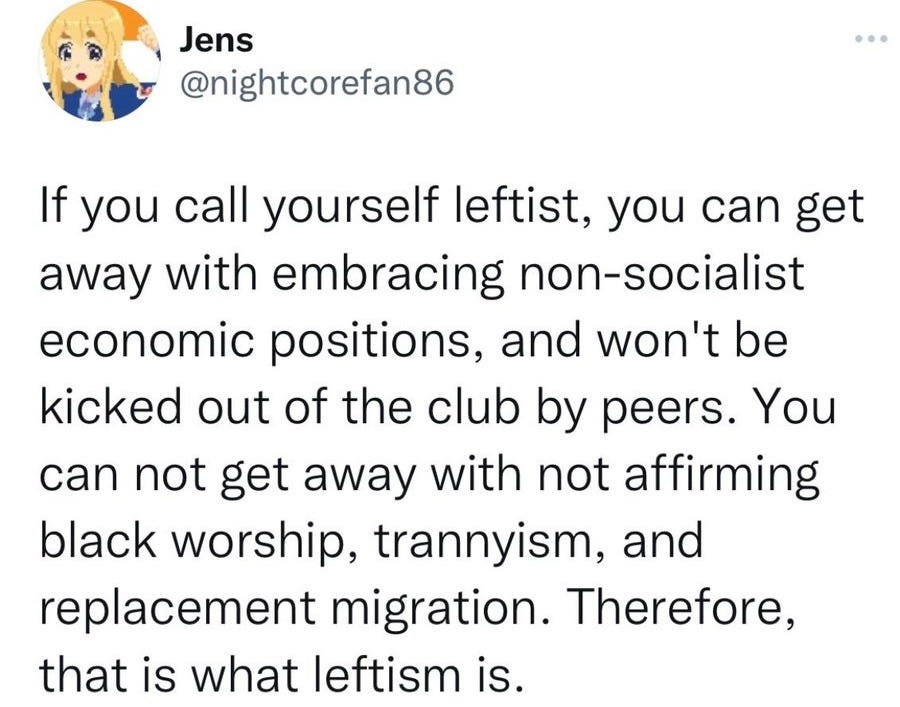
If you call yourself a leftist, you can get away with embracing non-socialist economic positions, and won’t be kicked out of the club by peers. You Cannot get away with not affirming black worship, trannyism, and replacement migration. Therefore that’s what leftism is.
The left sets the moral boundaries of any conversation using appeals to race, gender, and imperialism, ironically enough, to cover up their obvious class contradictions. Perhaps this is the primary reason the woke can never truly be put away by leftist believers, despite what other problems they might be having politically. Therefore, as long as modern progressive identity continues to exist, it will hold its commitment to the cause of Civil Rights much more tightly than its allegiance to socialism and class struggle.
The cult of race-communism, feminism, and LGBTQ+ is here to stay, though perhaps not in the form we are used to.

Failed Progressive Mode Four: Confident Bourgeois Feminism
In its primal form, feminism is perhaps the ne plus ultra of modern political modes. At once a seemingly immortal fixture of politics, such ideology comprises a myriad of political tropes which inevitably emerge when females (or effeminate men) contest over political issues. For a modernity so thoroughly dominated by democratic thinking, and a demos so thoroughly dominated by women, how could the modern world not be a feminist age?
I suppose it depends on what we mean by “feminism”.
Man will never be completely free from feminine politics as long as there is woman. However, feminism, in the modern 20th-century sense, is very much a temporal phenomenon particular to the last century. As such, the feminist movement as we know it today appears to be in a state of decline, locked inside a perspective that makes little sense in the new world.
For all its other qualities as another instance of eternal female politics, the feminist project of the 20th century was largely organized around managing sex and gender norms inside the decline of classic Christian ethics and the rise of the Neoliberal state. There were two successful revolutions in the 20th century, one sexual and the other managerial. And the task of marrying these revolutions fell to the brave soldiers of the feminist movement, emancipating women from the expectations of family and children so they could more perfectly align with the expectations of managerial corporatism.
From a more realist view, I do not recognize a meaningful difference between the waves of women's liberation, gay rights, trans acceptance, and the rest of the alphabet that follows after. It's one seamless movement to fulfill the promises of the 20th century, away from the specific bonds of community, family, and moral norms, and towards individual autonomy, emancipation of hedonistic desire, and dependence on the total corporate state.
Still, the slogans were easy to sell to people who felt that society was stifling their desire’s ambition.
Let a thousand flowers bloom!
Follow your joy!
Different strokes for different folks!
If you are anywhere near my age, you have heard these feel-good slogans about sexuality at all levels of media and education. This is just how things were in modernity, and modern people needed an open and egalitarian attitude towards sex that was practical, healthy, and open. The feminist message was consistent, from politicians to scientists, to science guys.
But now it has failed.
Do we really need to comment on the failure of this alternative in 2025? After Tinder and OnlyFans and the "Me Too" generation? After “girl bossing”, “lazy girl jobs”, and “girl dollars”?
We might start with the fact that the post-sexual revolution vision of human sexuality is over-idealized, seemingly designed by people with no knowledge of how men and women work, a plan for managing the sexual marketplace without even understanding there is a sexual marketplace.
But perhaps those problems are all too abstract.
Does it matter that post-sexual revolution societies don’t allow the new generations to reproduce themselves? Does it matter that post-feminist understandings of family are collapsing social relations writ large? Does it even matter that these perspectives cause young people to have less sex?
Perhaps not. But now, in 2025, people want to know why they are lonely and miserable and relationships don't make sense anymore; and the advocates of feminism and LGBTQ+ don’t have good answers, not unless you include things like blaming men and “Patriarchy” for the sorry state of the world.
It turns out that managing the delicate game theory of gender relations is harder than it looks, and feel-good platitudes paired with hysterical recriminations of “MAN BAD” don’t actually fix the problem.
Feminism doesn’t work. But, more than just “not working”, modern feminism is imploding due to core contradictions at the heart of its identity, represented in the two simple questions: “What is a woman?” and “Have women won yet?”.
“What is a woman?”
Matt Walsh was famous for asking the question “What is a woman?”, but the real question looming over feminism today is “What is a victim?”. The sexual revolution, like all revolutions, was waged in the name of the oppressed, the victims. If feminism is the banner of the revolution, its revolutionaries will eventually have to ask: “Whom is our revolution for?”
Are the beneficiaries of feminism just that half of the population, classically called “women”?
In classic leftist form, the answer to this question must be “no”. The revolution was never just restricted to one group. Instead, the revolution must be for an ever-growing constituency of the “oppressed” expanding its horizons and ambition until it loses coherence and collapses into itself.
This is forever the pitfall of entropic political ideologies. When the movement for women’s liberation started, the victims and oppressors occupied clear roles, and abolishing the apparatus of that oppression had clear benefits for the former group and costs for the latter.
And, as long as that general form maintained itself, the coalition of the revolution could be expanded indefinitely. Hence, the ever-expanding coalition of alphabet letters, from Lesbians to Gays, keeps the flame of sexual emancipation ever-marching forward. Human sexual perversity being what it is, perhaps then the revolution could go on forever? But problems inevitably come about.
At its core, despite what other groups involved themselves, the cause of sexual liberation and feminism was primarily about women and their female approach to politics. In democratic systems, women have an advantage. They are essential to society’s reproduction, making their concerns hard to ignore and their role in society generally non-expendable. Furthermore, women have a natural political tendency to coalition with all other women against what they perceive as harmful male action.
Such a tactic is probably a necessary female adaptation, a counterbalance born from millennia of living in male-led societies. However, in “democratic” managerial systems, this type of sexual politics is an incredibly effective and deeply perverse political formula where coalitions of women can demand actions in the name of their unquestionable victimhood and then avoid accountability for any negative consequences of those actions. The collective of all women fighting against the wrongdoing of all men is simultaneously society’s most vulnerable political victim and its most dangerous political predator, lashing out to crush its enemies while being insulated from backlash or blame. In a democratic system, such an approach to politics has everything to gain and nothing to lose.
Aren’t you going to acknowledge our lived experience? Don’t you “believe all women”?
But then again. What is a woman?
Immediately, problems start emerging once the sisterhood‘s coalition starts expanding beyond reason and therefore has to answer hard questions. As many have pointed out, despite the propaganda of feminism, women still need scarce resources and they do compete with each other. And as much as the rhetoric of “MAN BAD” is popular within the longhouse, it can’t ultimately obscure the fact that females are their own worst rivals, contesting for things they all want, but can’t all have, not least “high status” and relationships with “high status” men.
Furthermore, being democratic in nature, female-led systems have a tendency to degrade the resources they rely on to function. Inevitably, the utility and cohesion that supported the group is exhausted, and everything begins to fall apart. There are fewer families, fewer babies, less sex, and less happiness.
The only thing female-style politics generates more of is neediness, dependence, and victimhood. Perhaps that’s unsurprising, since those are the things that female-led systems reward. And needless to say, those systems are very, very easy to game.
Famously, feminist social systems incentivize and produce the very types of men who victimize women: degenerate, abusive, and weak men who excel at aping the popular victimhood narrative while exploiting those around them. It’s funny that feminism, an ideology almost entirely focused on critiquing male behavior, never produces better men. But perhaps this is not surprising, since to train better men, you would actually have to understand how sex and gender roles work, how sexual degeneracy ultimately hurts women, and how boundaries are needed. But preserving boundaries was never feminism’s strong suit.
Yet, the real problems with feminism didn’t emerge until the boundary around “womanhood” started to collapse with the emergence of transgenderism. Female suffrage could survive two world wars, but it wasn’t clear whether it could survive the flood of AGP men into women’s spaces.
Sure, these new “trans” women were indeed victims and “women” by the definitions provided by orthodox progressivism. But to the eyes of any cognizant female on the ground, these trans creeps were the exact kind of low-quality degenerate men that the feminist sisterhood was supposed to guard them against.
Sure, leftists might condemn that creep “incel” who thought he had the right to ask you for a date in an elevator. But somehow those same leftists found it impossible to make a coherent condemnation of the pervert who walked into the locker room and announced his pronouns before getting undressed, full monty. Women owed men nothing because they were oppressors, yet somehow, women owed transwomen everything because they were bigger victims.
How long would it be until this new victim class was owed sex?
The revolutionary logic was unassailable. To be properly leftist, feminism must push ever downwards to more marginalized victims, enlisting ever more resources to service ever more degenerate desires. Still, despite the rhetoric, no move in this direction could possibly be portrayed as benefiting real women, and no amount of language games could cover up the harsh reality of what was going on: women’s spaces and women’s bodies were being used in the service of perverse male desire rather than being shielded from its abuse.
Therefore, feminism had a choice in front of it: cease being revolutionary, or cease being pro-woman. The reactionary feminist was born.
“Have women won yet?”
At this stage, writing in the Summer of 2025, feminism is experiencing something of a Thermidorian reaction within its ranks. The trans-insanity has crested and fallen. The TERFs are triumphant, and it’s obvious that there is going to be a reconsideration of many progressive directions entertained by feminists in the 2010s, perhaps even a return to second-wave orthodoxy.
Maybe now being a feminist means prioritizing women, and not those strange, perverted men who want to hop on the bandwagon of the revolution to justify their fetishistic fantasies.
There is just one problem. The revolution doesn’t stop. And once a movement draws a line and says “equality to this point and no further”, it is fundamentally reactionary. It is obviously defending some privileges over others, and the logic of leftism no longer serves its intended purpose.
Sure, when it comes to the minority of Autogynephilic men, the question of victimhood and privilege might be swept under the rug. Society doesn’t want to entertain that group’s grievances anyway. But when it comes to assessing the state of feminism generally, with its many victories and secured benefits for female-kind, many people might ask themselves: “Have women won yet?”.
I mean, not to be that guy, but if your movement is based solely around propounding on one’s victim-hood, women in the modern world are looking somewhat privileged relative to their immediate male counterparts.
In 2025, girls and women are winning against men. They have more education, fewer social problems, and, now, in younger generations, better pay. But despite what feminists might say, females are given an enormous number of unearned advantages in modern society. There are set-asides and “head-start” programs in fields where they are not yet dominant. Lobbying groups and Human Resources departments ensure that their political interests are respected both in government and the corporate world. And then there is the reality that an enormous number of these popular “girl boss” jobs are transparently manufactured. Moreover, sociologically speaking, people also tend to just like women more, generally.
Nevertheless, none of these advantages can ever be part of the discussion over sex and gender relations, where eternally the narrative of “Woman Victim” / “Man Bad” must reign supreme.
To be clear, I have had my fights with the MRA / “men need help” types over the years. I don’t think victim-based politics is a valuable approach to most problems, men’s problems especially. Of course, human communities have losers. There always comes a point where society must say, “Too bad you are on the bottom now,” to a certain subset of people. However, once that subset of losers grows to include a majority of men, now so economically disempowered they have difficulty attracting a wife, then your civilization is going to have serious problems. There is a price to be paid for this type of inequality, and I don’t think the modern crop of girl bosses is willing to pay it.
Increasingly, in the current year, I have noticed that many feminist thinkers have been trying to bite the bullet when it comes to declaring victory in the sex wars. Sure, women are winning, men are losing. But those are just the breaks. You guys should have worked harder and saved your pennies, but now that the women have won, it’s time to take direction from the new order of girl bosses, sit down, shut up, and come to terms with being broke incels on the bottom of modern civilization’s status hierarchy.
Certainly, this tough-luck attitude towards power is common throughout history. It is the mode of politics that buttressed all conquerors and justified all harems. However, such triumphalist stories don’t sit comfortably on the brows of our new girl boss overlords. The explanation doesn’t serve the purpose.
The problems with these types of justifications based on conquest are legion. But we might start with the fact that, unlike the great men of excess wealth from past times, women of excess wealth don’t actually reproduce themselves. Instead, hypergamy being what it is, elite women have a bad habit of pricing themselves out of the mating market and leading otherwise barren lives. The girl boss might be a ruling class for now, but she sits on top of a society in demographic collapse.
The women leaders now delighting in male tears aren’t so much ruling an order as they are cannibalizing it, subverting the healthy modes that once existed and then cackling at the misery of those that the new perverse system crushes. They are much less cloying and blameless handmaidens of inequality, much more vain and degenerate witches.
Furthermore, while the new female “elite human capitalists” trumpet their own power, no one is going to forget that their positions were derived from privileges awarded to them based on their perceived victimhood. Ultimately, girl-boss feminism suffers from the same problem as all revolutionary leftist political formulas that use oppression to justify the seizure of power. The justifications for revolutionary rulership abolish themselves the second that the revolution succeeds, and a society’s new masters find themselves groping for new justifications to buttress their authority and privilege.
Inevitably, ascendant revolutionary ruling classes resolve to justify their power by creating hysterical and overblown mythologies to demonize the old regime and its beneficiaries. While necessary, such justifications for power can be problematic. Political formulas based around scapegoating have obvious downsides and pitfalls, as they organize society around a vindictive sense of revenge. However, at least in the case of things like Communism, the political formula eventually stabilizes, as in the USSR, where the demons of old Czarism eventually went from being a real class needing to be liquidated to a semi-mythologized justification for Soviet Power.
But how much worse would such a scapegoating political formula be when directed against a class that necessarily comprises half of the population, a class that is not going to just “go away” once its societal role has been abolished?
After all, the girl bosses didn’t win a war to get their power. It was gifted to them under conditions of peace. And as the political rancor of women necessarily increases to justify their privilege, women will find themselves within an unstable political order. Men are generally willing to accept regimes where the bottom 30 percent of their sex is functionally left behind economically and socially; they will even accept 50 percent in a pinch. However, put men under the heel of a ruling class that defames them across the board, crows about its superiority, and then locks them out of critical opportunities, and you have the beginnings of a rebellion on your hands.
Such a situation is a tinderbox. Entropy increases, and society eventually uncovers the reality of total war. And total war is where the buck stops, female-centered politics fails, and feminism dies.
Perhaps some feminists think that young women are going to win an all-out war with young men, a last crusade to permanently liquidate that hateful caste that includes their sons and fathers. But I doubt any such project will succeed. No female political entity has ever succeeded in a contest of raw force throughout all human history, full stop. Maybe the TERFs and RadFems think they will be the first?
They are welcome to try, I suppose. But they should remember that the stakes are death, and tears don’t count for anything in real war.
Failed Progressive Mode Five: Egalitarian Post-Racial Utopianism
Whatever other leftist ideas are now defunct, I think one vision still stands above the rest: the progressive dream to end group conflict, and, subsequently, history itself.
On the surface, perhaps the most noble idea the left has ever forwarded is that all large-scale conflicts might be solved through the proper application of reason and discourse. The force of reason, having given us so much in terms of science and its subsequent reduction of plague and famine, it seemed only logical that yet another horseman of the apocalypse would fall under the relentless wheels of historical progress.
Moreover, until the beginning of the 20th century, it seemed plausible that large-scale human conflict might come to a close, rendered obsolete by the development of technology and modern prosperity. As the advent of the Great War shattered that optimism, the development of a new radical political theory of group identity and conflict was seen as necessary, with luminaries like H.G. Wells proposing cosmopolitan solutions to human violence.
If the problem was conflicts between nations, the root cause must naturally be the nations themselves, the primitive divisions between peoples by color, banner, and creed. In turn, the only proper progressive solution to the beast of war was to do away with the idol that inspired it. Remove even the existence of human group particularity by mixing it out of existence, and you would inevitably remove war. The ideology of 20th-century anti-racism was born.
Thus, for world peace to be realized, all notions of particularity held by European peoples had to be deconstructed under the rubric of this crusade: colonialism, imperialism, theories of race, and dogmatic religion.
Perhaps even Western Civilization itself needed to be abolished?
Maybe someday. But in the short term, the key to a more peaceful and orderly world just involved removing the external causes of discrimination and exclusivity.
The idea looked good on paper, it was easy enough for a child to understand, and not too difficult to implement on a personal scale, as good-hearted people could feel like they were working towards a truly better future just by being more open-minded and less set in the traditional modes of identity they didn’t want to maintain anyway.
War, the greatest of all human evils, could be solved so easily, just by breaking down borders, welcoming the stranger, and not being an asshole. But, needless to say, the project was doomed because it was based on a fundamental misunderstanding of human anthropology and politics.
To start, politics (and subsequently war) is not some emotive reaction born from national and class divisions. Rather, politics is a natural human adaptation to the conditions of life and the competition for scarce resources. Group conflict is not irrational, but rather a game-theoretical response to competition and evolutionary pressure paired with the individual desire to secure resources and status. Simply removing the superficial boundaries around groups of humans does not address war’s central motivation or cause.
Furthermore, human groups are not at their core interchangeable. If disparate groups are compared, inevitable differences become apparent, not just superficially but in core behaviors and values. And these changes do not just go away with cultural conditioning, at least not in the short time frames that modern states care about.
Moreover, across all groups, the key cornerstones of human meaning and continuity are sustained through group action and group identity. This cultural power to support collective well-being is not born from adversity with out-groups, but rather through the reality of human community and sacrifice, which always focuses on specific cultures and creeds carried down through a line of patriarchs.
The boundaries inherent in such human cultural systems are critical to people’s investment in them. Thus, if such boundaries are loosened or outright deconstructed, all the critical benefits communicated by culture are themselves destroyed. Collectives of people are not so much “enriched by diversity” as they are degraded by it, finding their existence inside a homogeneous, post-cultural society being demoralized and atomized with human conflict and violence (ironically) growing worse.
Perhaps there is a lesson here about the folly of trying to crudely engineer human outcomes even for noble ends. If so, no one has been paying attention. Across the last 50 years, the major project of all mainstream elites has been to imminently swamp their native population with an unending stream of mass migration from the former third world. Far from their pretense to be democratic, this shift has been accomplished over the population’s repeatedly expressed will to the contrary. Yet the wheels of power keep rolling in the direction of diversity, crushing all those who dissent beneath its wheels, all avenues for objection snuffed, every chance for escape cut off by the ruling powers.
And the great irony is that everyone knows that post-racial multiculturalism doesn’t work. Even liberal leaders like Angela Merkel and Keir Starmer will admit it when they think they can get away with it. The realities of this failure are creeping ever closer with each passing year. Yet, the direction never stops: More crime, less cohesion, a loss of cultural identity, increased political polarization, and a feeling that everyone else in the host society is an enemy instead of a friend.
The situation is the exact opposite of what the early progressives had hoped for, replicating a state of war inside of nations instead of between them. Now, we have more conflict and it’s closer than ever, the “Bellum omnium contra omnes,” is now coming to a neighborhood near you.
However, he question remains why ruling classes, far from reconsidering their positions on immigration, now consider near-open borders a sacrosanct policy. Perhaps, because, at least until recently, such an attitude towards multiculturalism was a winning political formula that could be used against their enemies.
After all, there were economic gains still to be had from 20th-century economies of scale, and mass migration played into that trend. Furthermore, the demographic changes were initially minor, as they primarily involved elite newcomers who were willing to adapt to the host country's culture and make reasonable economic contributions. Therefore, the opponents of immigration could be portrayed as maladaptive malcontents who refused to make the necessary changes to accommodate an otherwise obvious improvement.
But this dynamic is no longer holding up. Newer waves of immigration are larger and have obvious negative impacts on their host countries. All the while, modern progressive educational institutions have ideologically given up on the project of “assimilation” to the extent that it was ever possible to begin with. Now, new immigrant groups pursue naked racial identity politics against the indigenous populations of their new homes, abusing the natives when convenient, and having their abuses excused or covered up by a government too embarrassed to admit its failure. In the meantime, the negative changes brought by lower community trust and elevated ethnic hostility are becoming impossible to ignore.
Many progressives now understand that the dynamics around immigration have changed. But they remain confident in their position. History might be taking longer than usual, but the benefits of diversity are inevitable, and sooner or later, people will learn to love their new and improved countries.
The attitude is utter cope.
Are people not going to notice the change? Or are they going to be otherwise brainwashed into believing that things were always this way? That European countries have always had high crime rates, low trust, and demographic profiles similar to those of Brazil?
This won’t work unless the elites invent new A.I.-mind-twisting technology to make people forget the recent past. And even then, I am not sure that a simple film reel from the old world won't disabuse them of their propaganda-infused illusions. And when the narrative fails, people will look around, understand what they have lost, and become justifiably angry.
But it gets worse. When the decline sets in, and nativism rises, recent immigrant populations will be struck with a massive sense of insecurity and develop bigoted political formulas to justify their presence.
Why do we, as Pakistanis, now occupy the lands of England even though it’s obvious we are not native to this island?
Why are we Africans, now in Paris, even though our ancestors did nothing to build its cultural legacy?
Why are we, as Indians, now a majority in Canada, even when we have no connection to its history?
It must be because British people are lazy and stupid!
It must be because the French are evil and racist. This is a payback for Colonialism!
It must be because Canada doesn’t have a history. At least it didn’t have a history until we came!
The stage is set for ongoing political conflict, carrying on for the foreseeable future, a new society built on division and suspicion, the absolute worst legacy to leave one’s children.
Obviously, childless progressives think they are going to dodge the bullet on these negative consequences. But eventually, the political winds shift, and the rising tide of color comes for their role in society as well.
After all, who do you think is going to rule the politics of resentment in the 21st century? Probably not some “white guy” who looks like Will Stancil or Matt Yglesias.
As the new immigrant communities become more sure of themselves, they are more willing to break with the left-wing orthodoxy, pursue nakedly self-interested political ends, and snub the ideology of the progressive intellectual white PMC in favor of their real friends. We are seeing the beginning of this process in Europe and some places in America, where minority politicians are comfortable promoting a level of ethno-narcissism, humiliatingly tolerated by their leftist allies.
Is Zohran Mamdani and Omar Fateh the beginning of this trend? Maybe, maybe not. But the process is underway, and the professional white progressive leader will imminently be a thing of the past.

And that’s the fundamental feature of the immigration debate of the 20th century that progressives never learned properly. They didn’t win because of the manifest benefits brought by immigration. They won by looking strong, by looking like the people who were unaffected by otherwise hostile circumstances, maintaining their social role as other classes were losing theirs. When the immigration waves finally eat the intellectual PMC’s opportunities, this dynamic will shift, and they will just be another prole class shouting “They took our JERBS!”.
As such, the losses that progressives suffer at the hands of people like Omar Fateh are going to feel worse than the losses they have suffered from the likes of Hillary Clinton or Donald Trump, because at last everyone will see the progressive white guys’ role for what it really is. They did not implement a post-racial society. They created a balkanized hellhole. They didn’t expand economic prospects for their fellow citizens; instead, they sold them to foreigners, cheering on the replacement until it came for them, ultimately destroyed by the circumstances they created and were too blind to recognize.
The progressive race warrior stands, not a victim, not even a traitor, but a cuckold.
At this stage, I know that any progressive still reading might fairly push back against my argument that leftism is a dead political identity in 2025.
After all, don’t all worldviews have their contradictions and incoherence? Don’t all movements have anachronisms and troubles with real-world implementation? Didn’t you say that, on the particulars, many progressives make good points about consumerism and economic vulnerabilities? And didn’t you also admit that your own “dissident right” has problems? Why can’t we take the good and leave the bad while still calling ourselves progressive?
But that’s rather the problem. You can’t call yourself progressive in 2025 because the identity is no longer meaningful in the modern world. The social position no longer exists. The job description has been eliminated.
When you identify as a “progressive” or “leftist”, in so many words, you are not communicating an affiliation with the broad social movement that existed across the 19th and 20th centuries, but are rather expressing something else, much less flattering. The various modes of the progressive identity are defunct, and so even the desire to pursue their original goals is radically anachronistic, working at cross purposes to the social realities as they exist on the ground in the 21st century.
For instance, suppose you want to be a benevolent champion of the working class? An activist in the mode of the old socialists who used their privileged positions as educated men to advance the cause of the less fortunate?
But you can’t, because none of these social circumstances exist in 2025.
Progressive politics, as it exists in the modern world, is actively hostile to the health and well-being of the working class. So the best you will be able to manage, as a progressive activist, is a kind of LARPy cosplay where you pretend to advocate for the working class, totally disconnected from the interests of that class, like Marie Antoinette pretending to be a shepherdess.
Alternatively, you may want to be an intellectual, making honest strides in discourse, considering all positions fairly, being open to all new ideas, and then selecting the best through independent reason.
Well, you can’t.
The academy has been corrupted to the core. The only way you get an academic position is by misrepresenting what education is, flattering the powers that govern intellectual fads, and then playing the role of petty thought police against the ideas considered hateful to the mainstream ruling class. And whatever else this sycophancy purchases you, no one will ever consider you an “intellectual” in the old sense of the word.
But, perhaps, you don’t care about intellect and just want to be an anti-racist advocate for peace and harmony, making sure that all cultures have a right to thrive, and ensuring that the people of Earth, in their multifaceted forms, coexist in peace?
But, it turns out, you can’t. That’s not how politics works. That’s not how race works. That’s not how culture works. And, inevitably, by fueling the process of global cultural homogenization, you won’t eliminate conflict; you will just eliminate meaning and societal cohesion. You will not be the herald of peace but just an enabler of Chaos, an actor who inevitably will be seen by future generations as either a fool or a traitor.
On the other hand, maybe you just want to be a feminist? A free spirit and sensuous soul who rages against the stifling restrictions of familial paternalism and an activist who fights for a world where everyone, even the weakest, can pursue their joy in sexual expression equally?
However, you can’t do this. Because that’s not how human desire works. Debauchery does not lead to joy. Equality is not possible. Degeneracy is not sexy. You can follow the logic of the sexual revolution to its logical conclusion, and become the wet nurse of the most maladaptive degenerate losers in human history. Or, alternatively, you can assert your privilege and stamp down on the lower orders of a hierarchy that you climbed with your tears, becoming less a heroic savior and more a spiteful witch. But neither role will be seen to be enviable or heroic by anyone who comes after you.
Or maybe, more than any of those other things, you just want to win. You want to be on the “right side of history”. You want to know that you are on the victorious side of things and that the necessary direction of human events will make your cause supreme.
Well, I have bad news for you. There is no necessary direction of history, not unless you count the continuous direction of all matter and flesh towards its end in death and Chaos. So if you really want to join the “winning side”, perhaps you could skip the extra steps and join the true cause of the Prince of Darkness Himself, the original Whig and author of all progress.
However, presuming that you love something more than the assurance of victory and can value something beyond materialism, you might want to take a different approach to politics.
Instead of looking for the victorious force of history, why not just examine the world as you see it and identify what things, among the various qualities of humanity, are noble, heroic, and beautiful? Why not make your cause something more transcendent and spiritual? The virtues that connect you to your land, your people, and the Divine Good behind it all?
Some people say this traditional approach is impossible in the modern age. But many others have followed just this path, myself included. It is possible to fight for the eternal good of Christ, and not simply the desires of fashion. You can turn away from your false idols of progress.
But, to be fair, this change comes at a cost. People will call you “right-wing”.
One of the better essays I've read on this site. I don't agree with everything, but directionally this is why I stopped calling myself a leftist. "Left" and "right" are largely 19th and 20th century conceptions that have little to no relevance to the modern day. Well done.
This was quite the read. I had never thought of it before. I myself had considered people thinking of “Progressivism as dead” to be smoking their own supply. But yeah…. Progressivism being dead does not mean an automatic W for the right. It just means the philosophical underpinnings of the Left are incoherent. Funny thing is this, whatever comes next seems to be worse, and literally and figuratively more gay. When the right speaks of “gay race communism” to describe this strange beast, they aren’t all that far off the mark.
I don’t think we have a very good term for where it is headed, but it won’t be like the kinda hippy teachers I had in high school